


Undoubtedly, social networking sites play a pivotal role in daily communication. Thus, virtue norms and habits are also built up unconsciously so that people can act based on that constructed ground. To find more about virtue norms on SNS, I tested one of the norm-breaching experiments – “The Oversharer” (Sandvig, 2011). I out will approach and “text-bomb” one of my acquaintances using only texting method on mobile phone for one day (noted that I am not too familiar with this person).
In this experiment, my subject is a girl of the same age that I first (and last) met during Shanghai holiday tour last May 2019. Mine and her family were in the same group. We talked on the plane, hung out 2 times in Shanghai, and decided to share numbers. The tool I used in this experiment is “Imessage”.
Basically, I threw a bunch of boring daily activities and photos of my cat to her. A few personal questions were included as well. The messages were quite dense at certain times, and her reactions also varies. Yet overall, most of the replies were short and polite especially on my sharing of daily activities and cat photos. For example, she gave compliments to the photos, and didn’t show any hatred despite her disliking towards cats (I find out this during Shanghai trip).
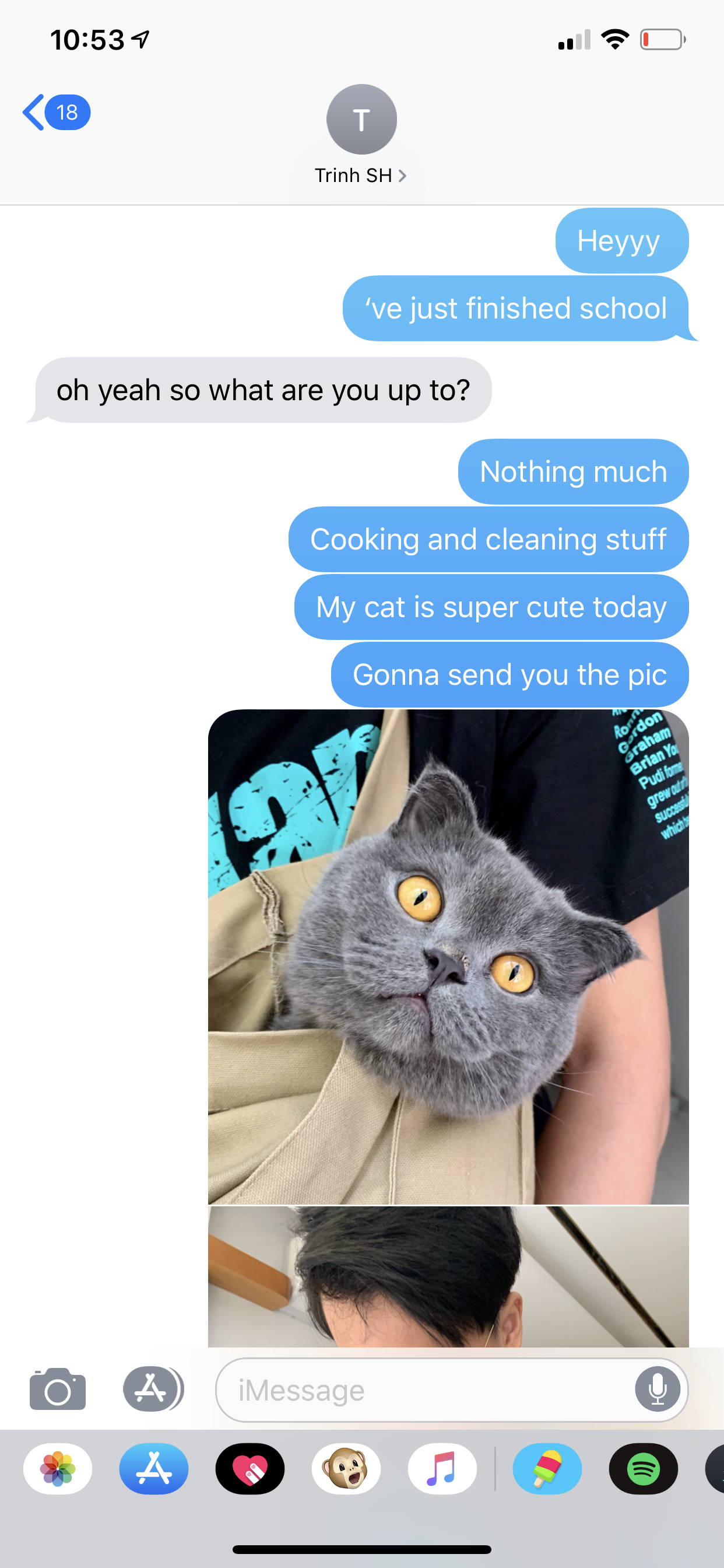
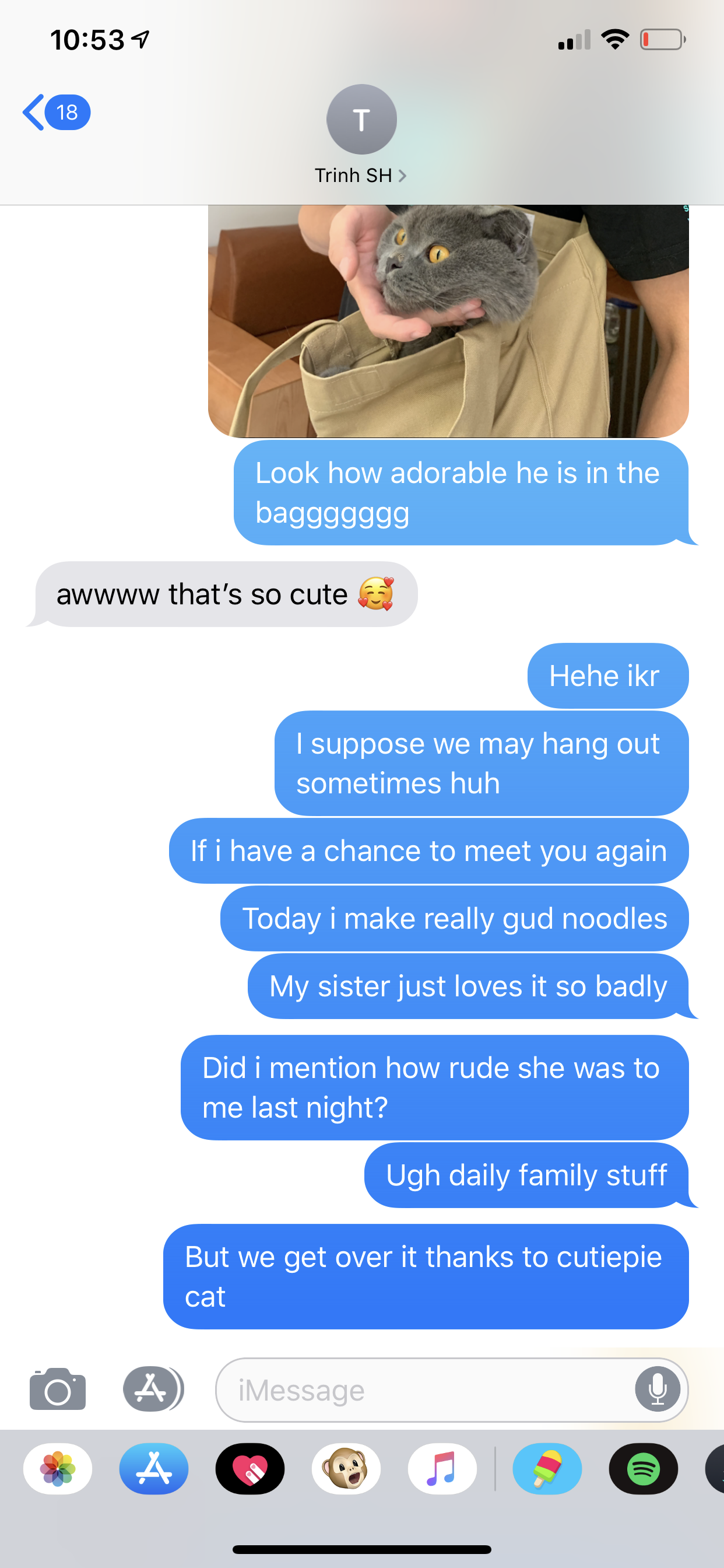
Sometimes she tried to cut the story politely by using short phases (“umm ok”, “good for you!”, “umm sleep since it’s 11”) but I can tell that she was somehow pissed off by my annoyance. When I tried to get into personal stuffs by asking questions about boyfriend, she finally acted a little bit tougher (“don’t you think it’s a bit too personal?”) but then immediately appeased me (“it’s alrighty”, “people need to share anyway”).

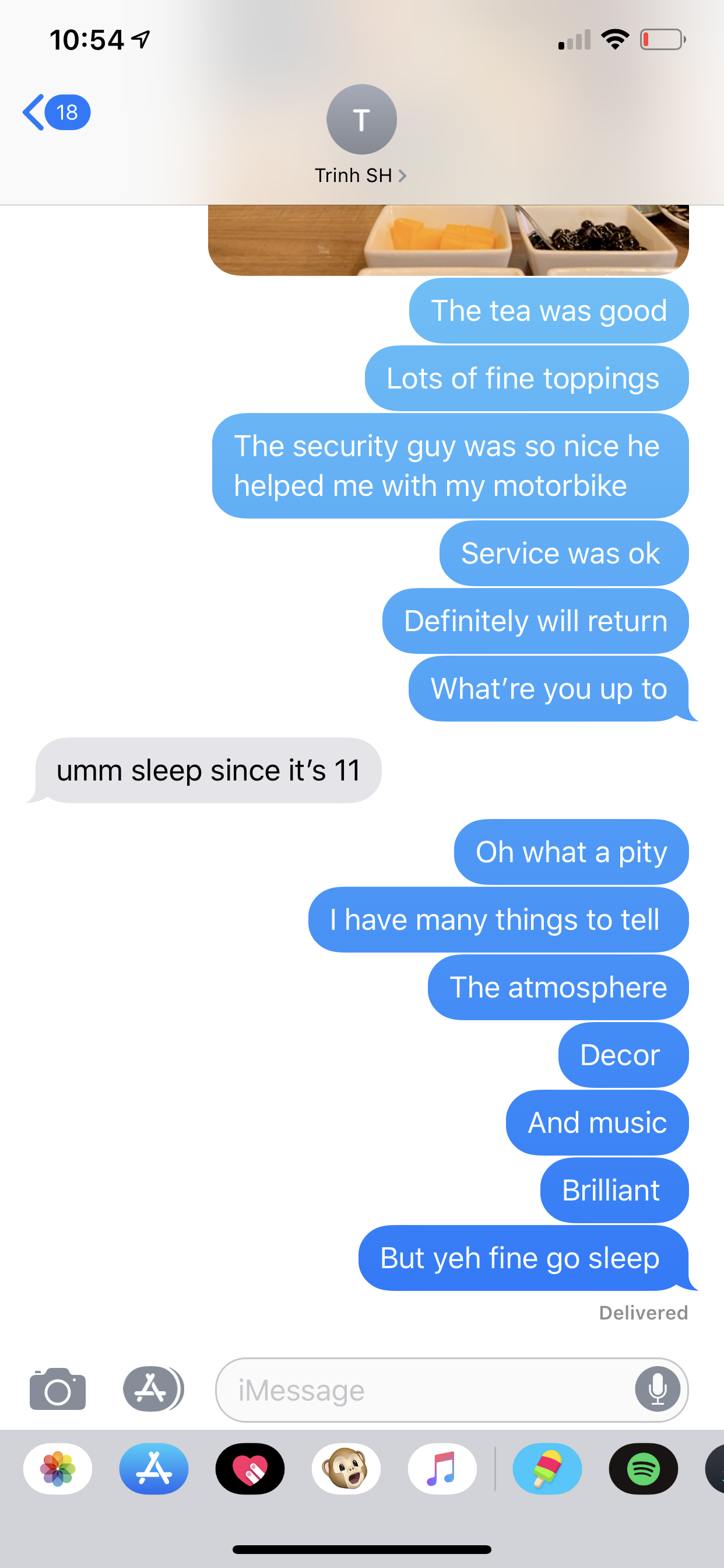
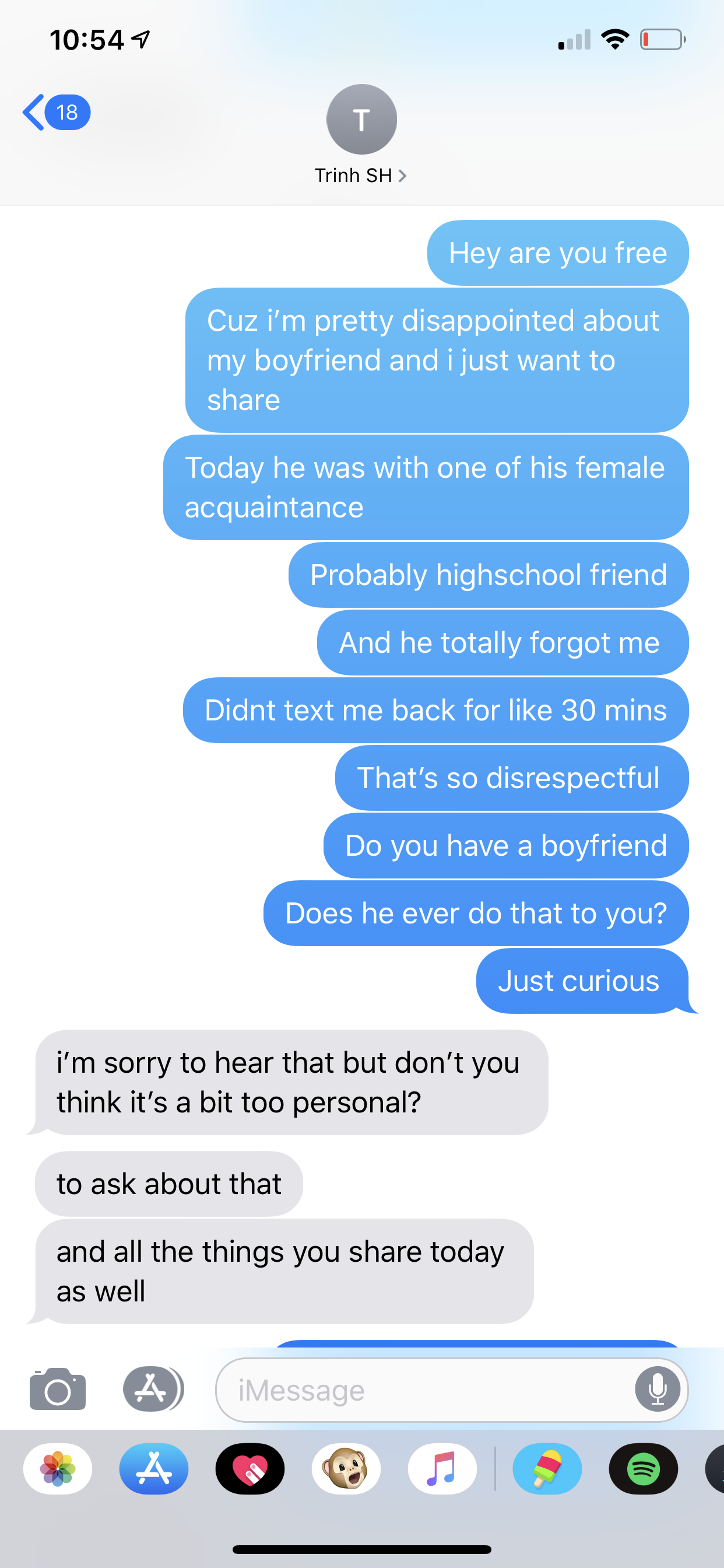
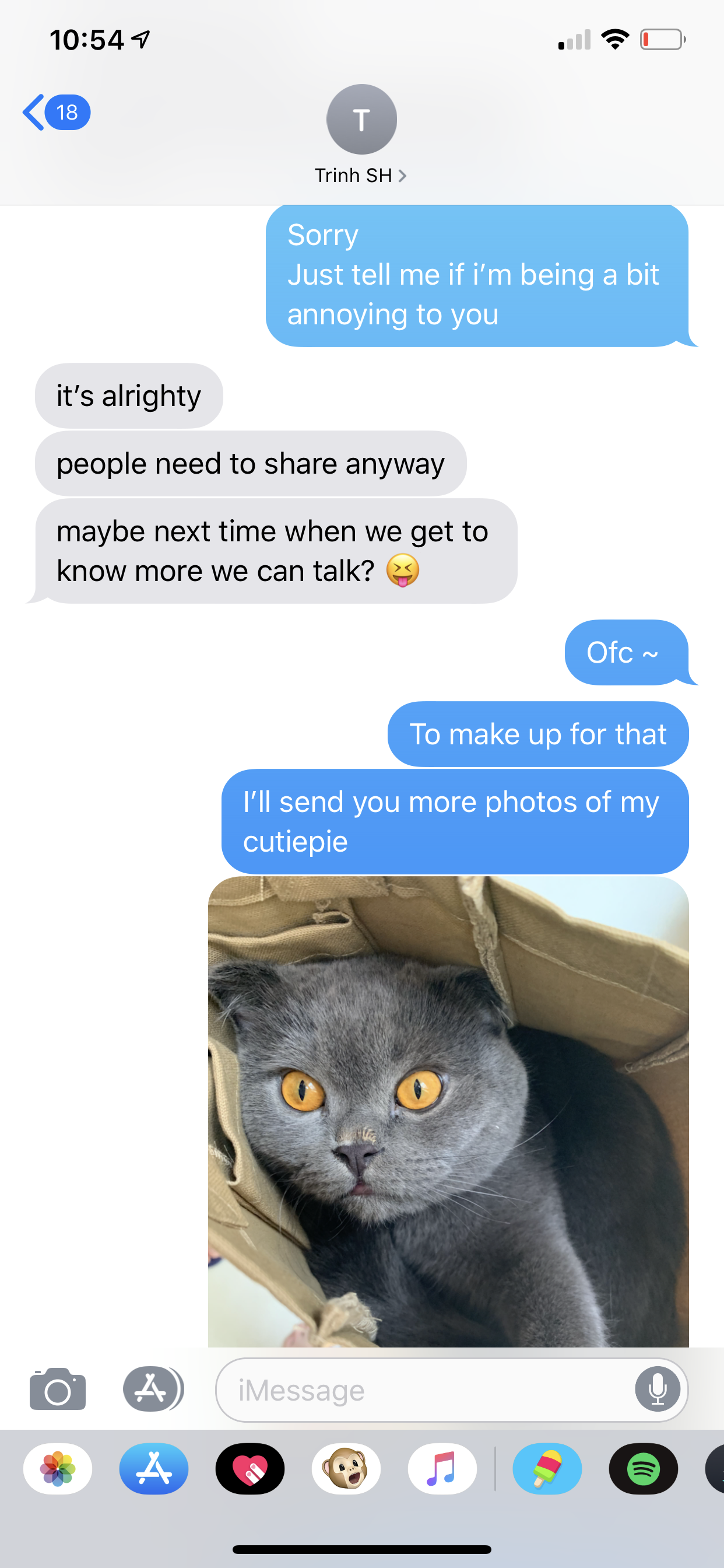
It can be concluded that the girl I text-bombed has unconsciously “taking-in” a “habitus” – the set of “values” achieved from “cultural history” which tolerated her to improvise to certain situations (Webb, Schirato & Danaher, 2002, pp. 36). In fact, the girl chose to act politely because she thought that her fine reactions are “necessities, common sense” (Webb, Schirato & Danaher, 2002, pp. 38), and most people in her situation would politely respond the same and try not to be rude. At least that is what would happen when using texting apps since people cannot witness each other’s facial expression.
Pearl.
References
Sandvig, C. (2011). The oversharer (and other social media experiments). Retrieved from https://socialmediacollective.org/2011/07/29/the-oversharer-and-other-social-media-experiments/?fbclid=IwAR2EyKZrSRQfpxRdKsO4p1X-FBf0Zcemw9eMDhf-VCSRFrxW78HunogoNJI.
Webb, J., Schirato, T. & Danaher, G. (2002). Cultural field and the habitus. In Understanding Bourdieu (pp. 21-44). London: SAGE Publications Ltd. doi: 10.4135/9781446221488.n2


